

Introducing Old Oscar Pepper 1916 Prohibition Medicinal Whiskey
May 15, 2026
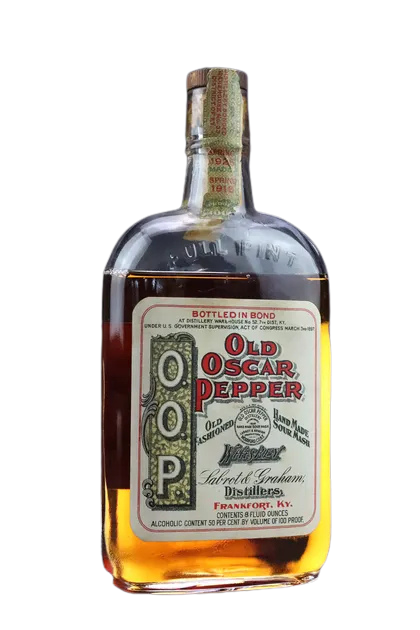
Some bottles are collected for what they taste like. Others are collected for what they survived. Old Oscar Pepper 1916 is a prohibition era medicinal bourbon now available at Collection 86, and it is both. Distilled in the spring of 1916 at one of the most storied distillery sites in American history, this bourbon sat in bond through a World War, the passage of the 18th Amendment, and the full onset of Prohibition before being bottled a decade later under the only legal loophole that kept American whiskey alive: a doctor's prescription.
This is not just a bottle of bourbon. It is a document. Collection 86 offers the Old Oscar Pepper 1916 as a primary source, sealed in glass, from a chapter of American history that nearly erased an entire industry.
The Distillery: Where Bourbon Became A Science
This whiskey was produced by Labrot & Graham at the Old Oscar Pepper Distillery in Woodford County, Kentucky, a site that has been home to distilling since 1812 and today operates as the Woodford Reserve Distillery under Brown Forman.
Oscar Pepper inherited the distillery from his father Elijah and brought on a Scottish immigrant named Dr. James Crow in the 1820s. Crow codified the understanding of sour mash fermentation, pot still distillation, and barrel maturation, processes that would go on to define bourbon as a category. After Pepper's death, the distillery changed hands through E.H. Taylor Jr. and George T. Stagg before being purchased by Leopold Labrot and James Graham in 1878. The stone buildings constructed from local Kentucky limestone still stand today.
When this whiskey was distilled in the spring of 1916, the distillery had been operating on that same ground for over a century. Two years later, it would go silent.
The Era: When Whiskey Needed A Prescription
In 1918, Prohibition caused the distillery to close. The remaining stocks were moved to concentration warehouses and sold for medicinal purposes through the Frankfort Distillery.
The Volstead Act contained a significant exception: liquor dispensed by doctors as prescription medicine. Only six companies were granted permits to sell medicinal whiskey, all bottled in bond at 100 proof, government stamped, and distributed with a prescription attached. Patients were allowed one pint every 10 days at roughly $3 for the doctor and $3 at the pharmacy, nearly $80 in today's dollars.
The irony runs deep. In 1916, whiskey was actually removed from the list of approved medicines. In 1917, the AMA voted in support of prohibition. And yet once it took effect, the AMA reversed course, in part because patients still wanted to drink. The prescription pad became the last legal bridge between Americans and their bourbon.
The Bottle
Old Oscar Pepper 1916 was distilled in the spring of 1916 and bottled in the spring of 1926 at The Frankfort Distillery. The bourbon matured for a full decade in barrel before bottling, bottled in bond at 100 proof, in a one pint format. The bottle itself is now over a century old.
The label reads "For Medicinal Purposes Only." Every detail, the tax strip, the government stamp, the bonded designation, the pint format matched to a prescription allowance, these weren't marketing decisions. They were survival mechanisms for an industry under siege.
What's Inside: A Vanished Style Of Bourbon
In 2013, the Los Angeles Whiskey Society opened a dozen prohibition era medicinal pints from the same 1916 and 1917 vintages. The results were revelatory. Tasters described whiskeys profoundly different from modern bourbon, characterized by bold, assertive rye spice and a flavor intensity that today's production rarely approaches. The unanimous conclusion: whiskey just isn't made like this anymore.
There are real reasons for that. Pre prohibition bourbon was distilled and entered the barrel at lower proofs. Distillers used proprietary yeast strains lost when their operations shuttered. The limestone water, stone warehouses, and slower production pace all contributed to profiles that are literally irreproducible today.
With 10 years of barrel maturation and bottled at 100 proof, Old Oscar Pepper 1916 sits in the sweet spot for these medicinal bottlings. Younger examples can drink hot and underdeveloped. Older ones sometimes show too much oak. A decade in barrel, from a distillery that had been perfecting its craft for a century, is the kind of confluence that makes collectors pay attention.
Why Collection 86 Carries Old Oscar Pepper 1916
Collection 86 features the Old Oscar Pepper 1916 Prohibition Medicinal Whiskey because of what it represents. This is bourbon produced at the site that gave us sour mash fermentation, that shaped the work of James Crow and E.H. Taylor Jr., and that now operates as one of the most visited distilleries in the world. The distillery was designated a National Historic Landmark in 2000.
This is not a bottle you open. It is a bottle you study. A century old artifact from a distillery that helped invent bourbon, bottled during an era that nearly destroyed it, carrying a label that reminds you of the absurd lengths Americans went to just to keep whiskey legal.
It is history you can hold in your hand. And there are almost none left.